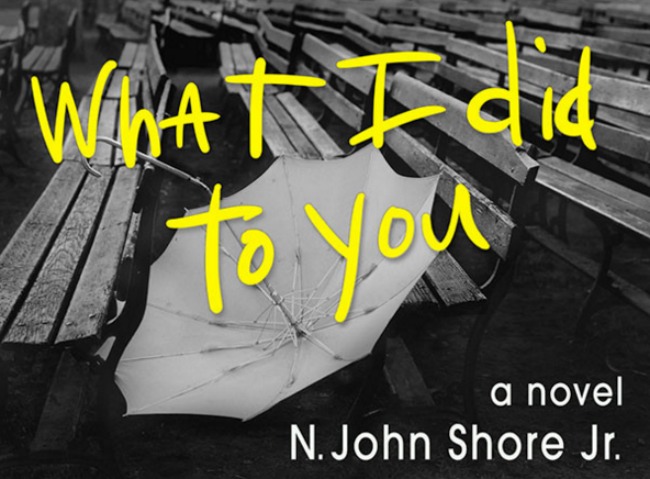
I recently ran a Kickstarter campaign for my first novel, What I Did To You. That campaign raised $33,431. I’m currently about the business of getting What I Did To You properly published.
Most of the novel takes place in San Francisco during the final months of 1979. It’s told from the point of view of a brilliant and lost young man named David Finch, who is living in a motel out by the sea, desperately trying to not just undo the wrong he recently did to the woman he loves, but to comprehend how he could have possibly done such a thing in the first place.
David is an extremely funny guy. But his past isn’t funny at all.
What I Did To You is about the raging lunacy, inexplicable durability, and ultimately liberating finality of love.
It’s about about the slow-drip toxicity of dysfunctional families. It’s about necessary deceits and unnecessary betrayals. It’s about friendship. It’s about the psychological sinkholes created by broken promises. It’s about the real-world damage done by homophobia. It’s about the dangers of sliding into isolation as consolation.
It’s about the glorious, agonizing, outrageous intensity of the human experience. (What novel worth the name is about anything less?)
Below is an excerpt from the novel’s first chapter (entitled “Its Usual Steady Roar”).
Driving home from the Los Angeles Airport, David was aware that the late morning traffic surrounding him was making its usual steady roar. But he couldn’t seem to hear any of it. It was like his ears were full of cotton.
Once back inside the plain, cookie-cutter Long Beach apartment of which he was now the sole resident, he felt like something between a zombie and a zombie who was capable, but only just, of making himself a piece of toast for breakfast.
Before she left Kate had packed her belongings that she didn’t take with her on the plane into boxes that were now taped shut, marked with her name, and neatly stacked against the living room wall.
As petite as she was—the top of her curly-haired head only reached the middle of David’s chest—Kate’s fresh absence from the apartment seemed to quadruple the size of the place.
Standing beside the table in its little dining area adjacent to the kitchen and looking into the apartment’s living room, David dropped onto the table his unbitten piece of toast.
“Oh, no, no,” he said hollowly.
He walked to the sofa in the living room, sat on it, laced his hands behind his head, and leaned back to look up at the ceiling.
He remained motionless for a long time.
Having received no useful feedback from the ceiling, he looked around the living room.
It was always so dark in there. That it received such scant natural light was the thing that he and Kate had most disliked about the place; she, a photographer, loved sunlight the way flowers do.
David jumped up off the couch, and attacked the blinds of the windows in the room in an effort to bring light into what now felt to him like a prison.
That bit of uselessness concluded, he moved to the center of the room. With his arms hanging listlessly he turned a slow three hundred and sixty degrees, taking in everything around him: Kate’s packed boxes, the television, the stereo, the open bedroom door, the wall furnace that made loud cracking sounds in the morning before it got hot enough to emit the smell of burning dust that he and Kate agreed was a weirdly comforting smell, the thrift-store kitchen table and chairs, the front door. Finally, gazing through the sliding glass door behind the couch at the tall puke-yellow fence surrounding the postage-stamp of a cement “patio” in front of their place, David repeated, “Oh, no.”
In a daze he walked into the bedroom. He’d barely been in there since breaking up with Kate the week before, after which he’d spent his long nights tossing and turning on the sofa.
He looked at the disheveled pile of blankets and sheets lying on the floor, all that was left of his and Kate’s “bed” after she extracted from it her sleeping bag, blankets, and her leopard-print sheets that he loved so much.
“No, no, no,” he muttered. Then, slightly louder, he said, “Did I really do this?”
He felt like he was having an out-of-body experience.
“Did I actually let this happen?” he said.
He seemed to float from the bedroom back into the middle of the living room.
“Am I this stupid?” he said. His breathing wasn’t working right. The only thing he could feel of his body was his heart, which was trying to pound its way out straight through his sternum.
Unable to stop it from happening, he fell to his knees.
He covered his face with his hands.
“Did I do this?” he cried. He began rocking back and forth, saying, “Did I do this?” over and over again, until his crying kicked in, hard, and he surrendered to the great, heaving, clutching waves of shock and grief that hauled him back and then pounded him forward, over and over and over again.
Finally he was left, ravaged to exhaustion and feeling something near to nothing, curled up in the fetal position on the green shag carpet, staring dumbly up at the stereo that he and Kate had not that long ago so joyously purchased together.
After a long while lying there, barely aware that he was moving, David slowly pushed himself upwards until he was seated cross-legged on the floor. But rather than sitting up straight, he slouched almost to the point of falling forward.
He closed his eyes.
Except for the sound of his own ragged breathing it was the purest silence he had ever heard.
And that silence was all he heard in response to his anguished, hammering question of how he could have done what he did.
David had met Kate one year before, during the 1978-79 school year at San Francisco State University, where David, who had spent the previous year working the graveyard shift at the Wrigley’s gum factory down the coast in Santa Cruz, was a twenty-year old freshman, and Kate, a stand-out in SFSU’s renowned photography department, was a twenty-two year old junior. Both were residents of Verducci Hall, the largest of three dormitory buildings on campus.
On a mid-October night, while sitting in a desk chair crammed into the corner of yet another extremely loud party thrown in someone or other’s dorm room, David had looked up to see, pushed by the swell of the party to nearly atop of him, a girl with naturally bronze skin and a shoulder-length mane of brown hair so curly Lewis and Clark would have given up half way through it. The combination of her big, Cleopatra eyes with her aquiline nose and strong jawline gave her the appearance of a a person too kind not to suffer fools at all, but too intelligent to suffer them for long.
When, having been forced into his space, the girl smiled down at him, David felt that she hadn’t just lit up the room; she’d outright blown it to smithereens.
Unable to stop himself, he said, “Jesus Christ.” He was relieved to know that the deafening music and crowd had muted his words into silence.
“What?” the girl mouthed to him. Then, moving with grace just precise enough to hint at the years that David would later learn she had spent studying ballet, she put one hand on her hip, used her other to hold back the thicket of her hair on one side, and leaned forward to bring her ear closer to his mouth, the better to hear him. And suddenly David found himself within licking distance of a caramel-colored neck so fine he quickly imagined a swooning Dracula choosing to starve to death rather than fuck it up. Not to mention the view down the woman’s shirt, not that he stared because that was rude but an unembellished tan bra and was he too young to have a heart attack?
“Nothing!” he said into her ear. “Sorry!”
She resumed her perfectly straight standing posture, and thrust out to him the long-fingered hand of an artist. As he slid his large palm over hers she once more bent forward, this time to bring her lips as close to his ear as smoke is to fire.
“I’m Kate!” she said, pumping his hand.
“I find your ingenuous self-possession mesmerizing” is what he might have said. What he did say, though, was, “I’m David. David Finch.”
From behind her the party closed what was left of the gap between them.
“I think I’m going to have to sit on your lap!” she yelled.
“So there is a God,” he said.
“What?!”
“Nothing! Have a seat!”
Twenty minutes later the noise level in the room had been mercifully reduced by half, and Kate was still perched upon his lap.
Moving her mouth near to his ear, she said softly, “It’s surprising how comfortable I am sitting here.”
“Not to me it’s not,” he said.
“No?”
He shook his head. “No. I’ve been preparing for a moment just like this for years.”
“You have? How?”
“By carefully and diligently storing a truly freakish amount of fat in my thighs.”
Kate let out a laugh so loud that half the people in the room turned to look at her. Once she and David were back out of the spotlight, she said to him, “Are you always so funny?”
“Only when I’m overwhelmed,” he said.
She pulled her head back and spent a long moment studying his face.
“I like you,” she said.
“I like you, too.”
“I’m going to kiss you now.”
“I’m going to let you.”
Adam couldn’t have been more amazed the first time he kissed Eve.
From that night on, David and Kate were inseparable.
Except for the five or so hours that David separated them.
One afternoon, about three weeks after meeting her and storming into her life like the Invasion of Normandy, David, out of nowhere, told Kate that he thought the two of them should stop seeing each other.
“I just … I don’t know,” he said. “I think you and I are just something that I … can’t … that I need to sort of maybe not be a part of right now.”
They were in Kate’s dorm room.
When she heard what he said, Kate stopped folding her laundry.
After a moment’s thoughtful silence, she said, “Well, I’m surprised to hear you say that. But if that’s how you feel, then that’s how you feel.”
She didn’t seem upset. At all.
“Was there anything else you wanted to say?” she said.
“No,” said David, suddenly unsure of what exactly was happening. The girls with whom he’d broken up in the past had always rather dramatically fallen apart. Not that he liked that; it was awful.
But was that ever not being a problem now.
“Well then,” said Kate, folding the last of her laundry. “I’m meeting a friend for brunch downtown, and I’m already late. But I’ll see you around, okay?”
“Who’re you going to brunch with?”
“Candy,” said Kate.
“Oh,” said David. “Okay. Well. Sure. Brunch is nice.” He felt like he was in a play that had gone bizarrely off script.
Two hours after he left it David phoned Kate’s dorm room.
When she wasn’t there, he waited a half-hour and tried again.
She still wasn’t home.
A half-hour later he tried again.
Still away.
Thirty minutes later, she was still out at what David could only assume was the greatest brunch in the history of complimentary champagne.
David decided to go out for run. Upon returning he called her before he’d even wiped his brow.
This time she picked up.
“Where’ve you been?” he said. What he had intended to sound breezily casual came out sounding something more like Chip or Dale halfway through a murdering spree.
“Out,” she said. “What do you want?”
“I was wondering if we could talk for just a minute.”
“Not right now,” she said. “I’m busy. Maybe later, okay? Gotta run. Bye.” She hung up.
A half-hour later David called her. “I don’t suppose it’s later yet, is it?”
“I just want to be sure about something,” she said. “You do know what the words ‘I’m breaking up with you’ mean, right?”
“I do,” said David. “Of course I do. I don’t know what is wrong with me. I think I’ve gone insane. I know I’ve gone insane. And you know why?”
“No. But I do know I’ve got some studying to do, so—”
“It’s because of you. It’s you. Everything is you. Everything in my mind is you. Everything in my heart is you. Everything in my bones is you. From the second I met you—from the second I saw you—I knew like I know my name that you were the person I would spend the rest of my life with.”
“Okay.” She sounded nonplussed. “And that’s bad because why?”
“Because I didn’t want to know that. I’m twenty. Who wants to know when they’re only twenty that their entire life has been locked down onto one single path, that all the possibilities that they at least liked to imagine might happen to them won’t, because everything about their entire future has just been shown to them?” There was a pause on the line. “Who can live with that?” he said.
“What do you want?” said Kate.
“I want you back, Kate. I’m begging you to take me back. I want you to forget this dumbass breaking up thing I did. I don’t want to break up with you. That was insane. You’re the greatest person I know I’ll ever meet. If you’ll take me back, I am completely in. I promise.”
A long, long, long pause happened.
“Bring me some flowers, and I’ll take you back,” said Kate.
“Okay. Yes. Yes!”
Within the hour David was knocking on Kate’s dorm room door, holding a bouquet of twenty-four red roses.
After opening her door, Kate silently looked David in the eye for as long as it took her to get whatever information she was after. Then she took the flowers from his hands, raised up on her toes, and gave him a quick kiss.
“I missed you,” he said.
“It’s been five hours.”
“Still,” he said.
Besides being impoverished students, David and Kate shared another, less common kind of poverty: neither of them had a family to stay with during their college’s three-week winter break.
That is, neither had a family they would consider staying with.
Kate was born in London, the result of a brief affair between her lily-white British mother, Elizabeth, and a young Egyptian physician from Cairo.
She had never met her biological father. She didn’t even know his name.
She did, however, know Caleb Prickett, the gregarious but cruel airman in the Air Force whom her mother married five months after getting her pregnant with the first of their three children.
Caleb and Elizabeth’s marriage took place when Kate was six years old. It marked the beginning of a long unhappy chapter of Kate’s life, which ended when, at seventeen, Kate was thrown out of her house with literally nothing but the clothes on her back.
She hadn’t been home since.
Kate remembered as a special and wonderful time her life before Caleb and her half-siblings—when it was just she and her mum, then a designer of dresses for a local department store, living by themselves in a their rather tony London townhouse. There, on a sunny day, with Kate wearing one of the cheery little dresses that her mother had made for her, the two of them would sit at their wrought-iron tea table beneath the eucalyptus tree in their small, perfectly square back yard, and enjoy a pot of tea together, which her mother would pour from her Royal Albert Old Country Roses teapot.
“That teapot was so amazingly beautiful,” Kate told David. “I loved it so much when I was a little girl. It seemed like everything my mother and I were, everything that was good about us and that time of my life, of our lives together.”
“Do you know where that teapot is today?” David asked.
“No, not at all. I don’t even know if it made the move with us to America. Even though I was only six when we got here, I think I’d remember it being inside our trailer in fucking Lost Hills, Kansas. It wouldn’t have exactly blended in with the empty mayonnaise jars and cockroaches. Maybe one of Caleb’s drunk relatives sold it for drug money.”
“From what you’ve told me about his clan, one of them probably did.”
Kate smiled sadly.
“How come you never bought yourself a teapot just like it?” said David. “No one loves tea more than you. And I think they still make Royal Albert teapots.”
“They do.”
“How come you’ve never gotten yourself one?”
“Oh, I couldn’t. I just … I couldn’t. I’ve thought about it a million times, though. A couple of times I’ve gotten as far as the cash register with one. But I could just never go through with it. It’s like … I don’t know. It’s like I want one too much to get one. Do you know what I mean?”
“I do,” said David. He cupped her face and kissed her lips. “I sure do.”
Upon returning to her dorm room after classes the following afternoon, Kate found David waiting for her. He was holding a big cube of a box wrapped in white paper with little red roses on it and topped with a green bow.
“Oh, my gosh,” said Kate. “Is this what I think it is?”
“There’s only one way to find out,” he said.
It was.
Sitting on her bed, looking up at David from the Royal Albert Old Country Roses teapot she lovingly cradled in her lap, Kate, smiling through her tears, said, “No one’s ever meant, ‘It’s just what I’ve always wanted’ more than I mean it right now.”
Four months later, with the end of the school year rapidly approaching, Kate and David needed a plan; they knew that they were hardly likely to get away with living for free in the dormitory for an entire summer.
“I was thinking,” David said to Kate as they were lying together in his dorm room bed. “My dad’s a head mucky-muck at that huge corporation down in Long Beach. Why don’t I call him and ask him for a summer job where he works?”
Kate raised her head off his shoulder to look at him. “Really?”
“Sure, why not?”
“Because it would mean asking your dad for help. I just can’t imagine you doing that.”
“I know; it’s weird. But he should be able to get me a job that pays well enough for you not to have to work at all, so that you can spend your time taking pictures. Summer jobs like that aren’t so easy to come by.”
“But I don’t mind working. I like working.”
“Change of plans, then,” he said, lovingly moving a few strands of her hair off her face. “We’ll have my dad get you something, and I can stay home all day drinking and whacking off so much that eventually my dick just falls off in my hand.”
Kate looked mock-excited. “Oh, that does sound like a fun summer!”
“It does!” said David.” Then I’ll get it bronzed. No, but seriously. What do I have to lose by calling my dad? My close relationship with him? I don’t think we’ve talked five times since I left home—what, three years ago? But I could see him helping me out. I’m still his son.”
“I just know how you feel about him, is all.”
David reached up to run a finger along the bottom of a poster he’d put up over his bed of Van Gogh’s Bedroom in Arles. “Nah, it’ll be all right.”
Kate put her head back on his chest. “Just don’t do it for my sake or anything. We have lots of other options.”
“I know we do. But this might be really nice.” He gave a slight shrug. “I’ll give him a call tomorrow, and just see how it goes.” … .
The next day, standing at the phone on the wall of his dorm room, David reached his father in his office.
“You’re in college,” said his dad. “You.”
“Yeah, Dad,” said David, looking up at the ceiling. “Me.”
“Where the hell are you going to college? Pick Your Nose U?”
David leaned his forehead against the painted cinder block wall and closed his eyes. “San Francisco State, Dad.”
“Pffft. Same thing. What kind of grades do you get?”
“I have a 4.0.”
“You get A’s,” said his dad flatly.
“Yeah, I get A’s.”
“What are you majoring in? Navel gazing?”
“Dad, please. I really need to ask you something.” Racing against the interruption he knew was certain to cut him off at any moment, David explained as much of his situation as he could before his dad cut in.
“Let me get this straight. The first time I hear from you in God knows how long, you want something from me. Why am I not surprised by that?”
David imagined himself cracking his head like a melon against the wall. “It’s not that I want something from you, Dad. All I was thinking was that if you have any sort of opening at your company for which I would be suited, that might be a nice thing for both of us.”
“Opening? What opening? There’s no opening. What the hell do you even know how to do? In case you’re not aware of this yet, nobody gets paid for sitting on their fat ass all day watching television.”
“I’m aware of that, Dad. But good career tip.”
“Jesus Christ. What the hell do you want me to do? What am I, an employment agency? I don’t have a job that I can just pull out of my drawer and give to you.”
David turned and leaned his back against the wall. “Okay. Don’t worry about it. It’s just something I thought I’d try. It’s no big deal. I’ll find something else.”
His father fell uncharacteristically silent. “Are you serious about this? You really want to move down here and work?”
“I thought it might be nice, yeah.”
“Just for the summer?”
“Yeah, that’s all.”
“All right, lemme see what I can do. I’m not promising you anything, you understand. But maybe I can scrounge something up for you. Gimme your number and I’ll call you back.”